
Books That Had Started Something
Ian Fleming is vooral bekend als de geestelijk vader van James Bond, maar zijn interesses reikten veel verder dan spionage, cocktails en snelle auto’s. Al in de jaren dertig ontwikkelde hij een bijzondere fascinatie voor boeken die volgens hem letterlijk iets in beweging hadden gezet.
Geen verzameling van uitsluitend literaire klassiekers, maar een bibliotheek van werken die een wetenschappelijke, technologische, maatschappelijke of culturele ontwikkeling hadden ingeluid. In Books That Had Started Something: Ian Fleming’s Book Collection vertelt Joel Silver het opmerkelijke verhaal achter deze collectie. Het 26 pagina’s tellende pamflet is daarmee veel meer dan een beschrijving van een verzameling boeken. Het is een fascinerend kijkje in de manier waarop Ian Fleming dacht, verzamelde en naar de wereld keek.
Een verzameling met een idee
In 1935 stapte Ian Fleming bij zijn vriend en boekhandelaar Percy Muir binnen met een duidelijk idee. Hij wilde een verzameling aanleggen van boeken die iets nieuws hadden geïntroduceerd: “books that had started something”. Het kon daarbij gaan om wetenschap, techniek, sport, transport, politiek of maatschappelijke ontwikkelingen.
Ian Fleming is best known as the creator of James Bond, but his interests extended far beyond espionage, cocktails and fast cars. As early as the 1930s, he developed a particular fascination with books that, in his view, had literally set something in motion.
It was not a collection consisting solely of literary classics, but rather a library of works that had initiated a scientific, technological, social or cultural development. In Books That Had Started Something: Ian Fleming’s Book Collection, Joel Silver tells the remarkable story behind this collection. The 26-page pamphlet is therefore much more than a description of a group of books. It offers a fascinating insight into the way Ian Fleming thought, collected and viewed the world.
A Collection with an Idea
In 1935, Ian Fleming approached his friend and bookseller Percy Muir with a clear idea. He wanted to build a collection of books that had introduced something new: “books that had started something”. These could relate to science, technology, sport, transport, politics or social developments.
The great thing about my collection is that fashions cannot possibly change in collecting Shakespeare and Galileo and that sort of stuff makes up 95 per cent of my books. The other 5 per cent, the literature section, I agree is more debatable.
Ian Fleming
Het concept was bijzonder voor zijn tijd. Waar verzamelaars zich vaak richtten op beroemde literaire werken of zeldzame eerste drukken, keek Fleming vooral naar de historische betekenis van een boek. Dat leverde een zeer eigenzinnige verzameling op. Tot de collectie behoorden onder meer werken van Charles Darwin, Karl Marx en Albert Einstein, maar ook veel minder voor de hand liggende publicaties. Fleming was geïnteresseerd in de eerste boeken over bijvoorbeeld golf, fotografie, film, auto’s, luchtvaart en andere innovaties. Zijn collectie vertelt daardoor in zekere zin het verhaal van de moderne wereld.
Percy Muir als gids
Een belangrijke rol in het verhaal is weggelegd voor Percy Muir, de Londense boekhandelaar die Fleming hielp bij het opbouwen van zijn collectie. Muir beschikte over de kennis en contacten die nodig waren om de vaak moeilijk vindbare boeken op te sporen. Fleming beschikte op zijn beurt over een scherp oog voor bijzondere exemplaren én over het geld om ze aan te schaffen.
Hun samenwerking was niet altijd probleemloos. Silver laat zien dat Fleming zijn verzameling niet uitsluitend uit liefde voor boeken aanlegde. Hij keek ook naar de potentiële financiële waarde. Fleming wilde soms goedkoop inkopen met het idee de boeken later voor een hogere prijs te kunnen verkopen. Voor Muir, die vooral de intellectuele betekenis van de collectie zag, moet dat niet altijd even gemakkelijk zijn geweest. Juist dat detail maakt Fleming als verzamelaar interessant. Hij was geen wereldvreemde bibliofiel die uitsluitend verzamelde uit passie. Hij begreep ook de markt.
Van golf tot relativiteit
Een van de leukste aspecten van het pamflet is de enorme diversiteit van de verzameling. Fleming verzamelde bijvoorbeeld vroege werken over sport en recreatie, maar ook baanbrekende wetenschappelijke publicaties. Zo bevatte zijn bibliotheek onder meer Einstein’s Die Grundlage der allgemeinen Relativitätstheorie, Darwins On the Origin of Species en Marx’ Manifest der Kommunistischen Partei.
Daarmee wordt duidelijk dat Fleming vooral geïnteresseerd was in ideeën. Het ging hem niet noodzakelijk om het mooiste of beroemdste boek, maar om het moment waarop een nieuw idee voor het eerst werd vastgelegd. Dat maakt de verzameling vanuit historisch perspectief bijzonder waardevol. Het concept sluit bovendien verrassend goed aan bij Fleming zelf. Ook zijn James Bond-romans waren in zekere zin een combinatie van bestaande ideeën, technologie, actualiteit en verbeelding. Zijn verzameling laat zien dat zijn belangstelling voor dergelijke ontwikkelingen al lang vóór Bond bestond.
De collectie als tijdcapsule
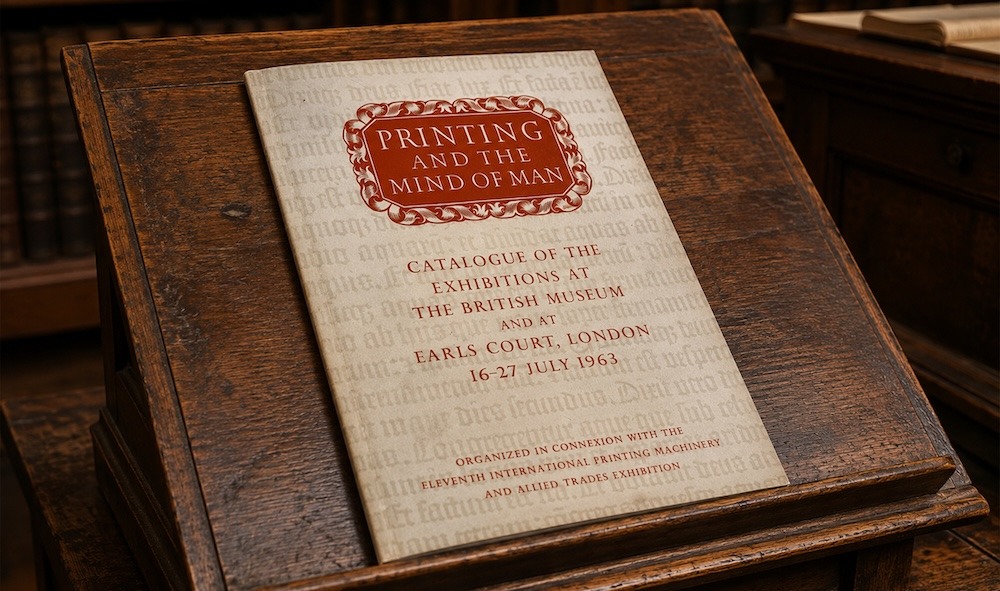
De collectie kreeg in juli 1963 een belangrijke rol bij de Londense tentoonstelling Printing and the Mind of Man, waarin de ontwikkeling van het gedrukte woord en zijn invloed op de moderne wereld centraal stond. Ian Fleming, die 44 boeken uit zijn bibliotheek uitleende, was een van de particuliere verzamelaars die aan de tentoonstelling bijdroegen en vormde daarmee een belangrijke bron voor deze tentoonstelling. Naast Flemings exemplaar van Mein Kampf waren er ook boeken te zien van Feud, Cury, Faraday en Lenin. Daarmee kreeg een privéverzameling, die oorspronkelijk vanuit persoonlijke interesse was opgebouwd, een veel grotere historische betekenis.
De boeken waren niet langer alleen onderdeel van Flemings bibliotheek. Ze vormden samen een soort tijdcapsule van menselijke vooruitgang. En dat is precies wat Silver in zijn pamflet zo goed duidelijk maakt.
The concept was unusual for its time. While collectors often focused on famous literary works or rare first editions, Fleming was primarily interested in the historical significance of a book. This resulted in a highly individual collection. It included works by Charles Darwin, Karl Marx and Albert Einstein, but also many less obvious publications. Fleming was interested in the earliest books on subjects such as golf, photography, cinema, motoring, aviation and other innovations. In that sense, his collection tells the story of the modern world.
Percy Muir as a guide
Percy Muir, the London bookseller who helped Fleming build his collection, played an important role in the story. Muir had the knowledge and contacts needed to track down books that were often difficult to find. Fleming, in turn, had a keen eye for unusual and interesting editions, as well as the financial means to acquire them.
Their collaboration was not always straightforward. Silver shows that Fleming did not build his collection solely out of a love of books. He also considered their potential financial value. At times, Fleming wanted to buy books cheaply with the intention of selling them later at a higher price. For Muir, who was primarily interested in the intellectual significance of the collection, this cannot always have been easy. Yet this detail is precisely what makes Fleming such an interesting collector. He was not a detached bibliophile who collected purely out of passion. He understood the market as well.
From golf to relativity
One of the most enjoyable aspects of the pamphlet is the extraordinary diversity of the collection. Fleming collected early works on sport and recreation, for example, as well as groundbreaking scientific publications. His library included Einstein’s Die Grundlage der allgemeinen Relativitätstheorie, Darwin’s On the Origin of Species and Marx’s Manifest der Kommunistischen Partei.
This makes it clear that Fleming was primarily interested in ideas. What mattered was not necessarily whether a book was the most beautiful or famous, but whether it represented the moment when a new idea was first recorded. From a historical perspective, this makes the collection particularly valuable. The concept also has a surprisingly strong connection with Fleming himself. His James Bond novels were, in a sense, a combination of existing ideas, technology, current affairs and imagination. His collection demonstrates that his interest in such developments existed long before Bond.
The Collection as a time capsule
The collection played an important role in July 1963 at the London exhibition Printing and the Mind of Man, which focused on the development of the printed word and its influence on the modern world. Ian Fleming, who lent 44 books from his library, was one of the private collectors who contributed to the exhibition and thus provided an important source for it. Alongside Fleming’s copy of Mein Kampf, the exhibition also included books by Freud, Curie, Faraday and Lenin. A private collection that had originally been assembled out of personal interest therefore acquired a much greater historical significance.
The books were no longer merely part of Fleming’s library. Together, they formed a kind of time capsule of human progress. And that is precisely what Silver conveys so effectively in his pamphlet.
De weg naar Indiana
Misschien wel het interessantste gedeelte van Books That Had Started Something is het verhaal over de uiteindelijke verkoop van de collectie. David Randall van de Lilly Library van Indiana University had tijdens Flemings leven al belangstelling voor de verzameling. Randall hoopte de collectie naar Bloomington te kunnen halen, maar Fleming verkocht haar tijdens zijn leven niet. Na zijn overlijden in 1964 duurde het uiteindelijk nog zes jaar voordat Percy Muir de verkoop wist af te ronden.
Dat betekent dat de collectie uiteindelijk pas in 1970 naar de Verenigde Staten verhuisde. Silver kan dit verhaal uit eerste hand vertellen. Als directeur van de Lilly Library had hij niet alleen kennis van de collectie zelf, maar kon hij zich ook baseren op correspondentie tussen Randall, Muir en Fleming.
Daardoor krijgt het pamflet een bijna detectiveachtige structuur: hoe ontstond de verzameling, wie hielp Fleming haar samen te stellen, wie wilde haar hebben en hoe kwam zij uiteindelijk in Indiana terecht?
Een bijzonder kijkje achter de schermen
Voor Bond-liefhebbers is vooral interessant dat Silver ook duidelijk maakt dat Flemings boekenverzameling iets zegt over de persoon achter James Bond. Dezelfde man die later romans schreef over een Britse geheim agent, hield zich in de jaren dertig al intensief bezig met de geschiedenis van wetenschap, technologie en maatschappelijke verandering.
Dat maakt Books That Had Started Something meer dan een bibliografische studie. Het is een stukje Fleming-biografie via zijn boekenkast. Je leert Ian Fleming kennen door de boeken die hij kocht. En misschien is dat uiteindelijk een van de meest persoonlijke manieren om een schrijver te begrijpen.
Een fraaie Queen Anne Press-uitgave
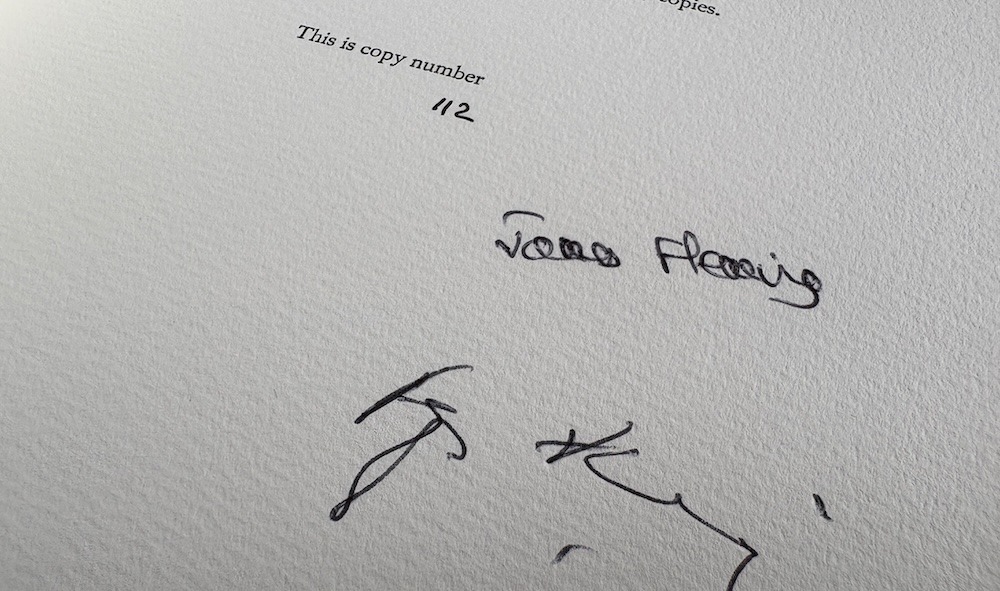
De afzonderlijke Queen Anne Press-editie verscheen in 2017 als een handgenummerde oplage van 125 exemplaren. Elk exemplaar werd gesigneerd door Fergus en James Fleming. Het pamflet werd gedrukt in Monotype Fournier en uitgevoerd met zwarte omslagen van flockpapier en een typografisch titellabel.
De vormgeving sluit uitstekend aan bij de inhoud. Het voelt als een bibliografisch object en niet als een gewone paperback. Bijzonder is bovendien dat sommige exemplaren vergezeld worden door een afzonderlijke offprint van het oorspronkelijke artikel, voorzien van afbeeldingen van verschillende boeken uit de collectie.
Met 26 pagina’s is Books That Had Started Something een zeer compacte publicatie. Wie een uitgebreid overzicht van Flemings collectie verwacht, zal daarvoor elders moeten zoeken. Maar dat is ook niet het doel van Joel Silver. Hij vertelt het verhaal van de collectie: het idee erachter, de samenwerking met Percy Muir, de bijzondere boeken die Fleming bijeenbracht en uiteindelijk de lange weg naar de Lilly Library. En precies daardoor werkt het pamflet zo goed. Het is geen catalogus, maar een verhaal over verzamelen.
The journey to Indiana
Perhaps the most fascinating section of Books That Had Started Something is the story of the collection’s eventual sale. David Randall of the Lilly Library at Indiana University had already expressed an interest in the collection during Fleming’s lifetime. Randall hoped to bring the collection to Bloomington, but Fleming did not sell it during his lifetime. Following his death in 1964, it took another six years before Percy Muir finally completed the sale.
This meant that the collection did not move to the United States until 1970. Silver is able to tell this story first-hand. As director of the Lilly Library, he had not only extensive knowledge of the collection itself, but was also able to draw on correspondence between Randall, Muir and Fleming.
As a result, the pamphlet takes on an almost detective-like structure: how did the collection come into being, who helped Fleming assemble it, who wanted to acquire it, and how did it ultimately find its way to Indiana?
A fascinating look behind the scenes
For Bond fans, it is particularly interesting that Silver also demonstrates what Fleming’s book collection reveals about the man behind James Bond. The same man who would later write novels about a British secret agent was already deeply engaged in the history of science, technology and social change during the 1930s.
This makes Books That Had Started Something much more than a bibliographical study. It is a small piece of Fleming biography told through his bookshelves. You come to know Ian Fleming through the books he bought. And perhaps that is ultimately one of the most personal ways of understanding a writer.
A fine Queen Anne Press edition
The separate Queen Anne Press edition was published in 2017 as a hand-numbered edition of 125 copies. Each copy was signed by Fergus and James Fleming. The pamphlet was printed in Monotype Fournier and finished with black flock-paper covers and a typographic title label.
The design complements the content perfectly. It feels like a bibliographical object rather than an ordinary paperback. Particularly interesting is the fact that some copies are accompanied by a separate offprint of the original article, featuring images of various books from the collection.
At just 26 pages, Books That Had Started Something is a very compact publication. Anyone expecting a comprehensive overview of Fleming’s collection will need to look elsewhere. But that is not Joel Silver’s aim. He tells the story of the collection: the idea behind it, the collaboration with Percy Muir, the remarkable books Fleming brought together and, ultimately, the long journey to the Lilly Library. And that is precisely why the pamphlet works so well. It is not a catalogue, but a story about collecting.

Conclusie
Books That Had Started Something: Ian Fleming’s Book Collection is een bijzonder waardevolle uitgave voor iedereen die geïnteresseerd is in Ian Fleming als persoon en boekenliefhebber. Joel Silver combineert bibliografische kennis met een fascinerend verhaal over een van de meest opmerkelijke privécollecties die Fleming ooit samenstelde. Het boek laat bovendien zien dat Flemings interesse in innovatie, technologie en maatschappelijke ontwikkelingen veel ouder was dan James Bond.
De Queen Anne Press-uitvoering maakt het geheel af. De beperkte oplage, de fraaie traditionele productie en de handtekeningen van James en Fergus Fleming maken dit pamflet tot een aantrekkelijk verzamelobject. Maar uiteindelijk zijn het de boeken zelf die de hoofdrol spelen. Fleming verzamelde niet zomaar zeldzame uitgaven. Hij verzamelde de momenten waarop ideeën de wereld veranderden. En misschien is dat wel de mooiste manier om de titel van dit pamflet te begrijpen.
n dezelfde serie verschenen ook de titels My Uncle Ian, Ian Fleming and the Book Collector en Two Bond Collectors. Recensies van deze uitgaven zullen binnenkort verschijnen.
Conclusion
Books That Had Started Something: Ian Fleming’s Book Collection is a particularly valuable publication for anyone interested in Ian Fleming as a person and as a lover of books. Joel Silver combines bibliographical expertise with a fascinating story about one of the most remarkable private collections Fleming ever assembled. The book also demonstrates that Fleming’s interest in innovation, technology and social developments long predated James Bond.
The Queen Anne Press edition completes the package. Its limited print run, fine traditional production and the signatures of James and Fergus Fleming make this pamphlet an attractive collector’s item. Ultimately, however, it is the books themselves that take centre stage. Fleming did not simply collect rare editions. He collected the moments when ideas changed the world. And perhaps that is the most fitting way to understand the title of this remarkable pamphlet.
Also published in the same series are My Uncle Ian, Ian Fleming and the Book Collector and Two Bond Collectors. Reviews of both titles will be published soon.
